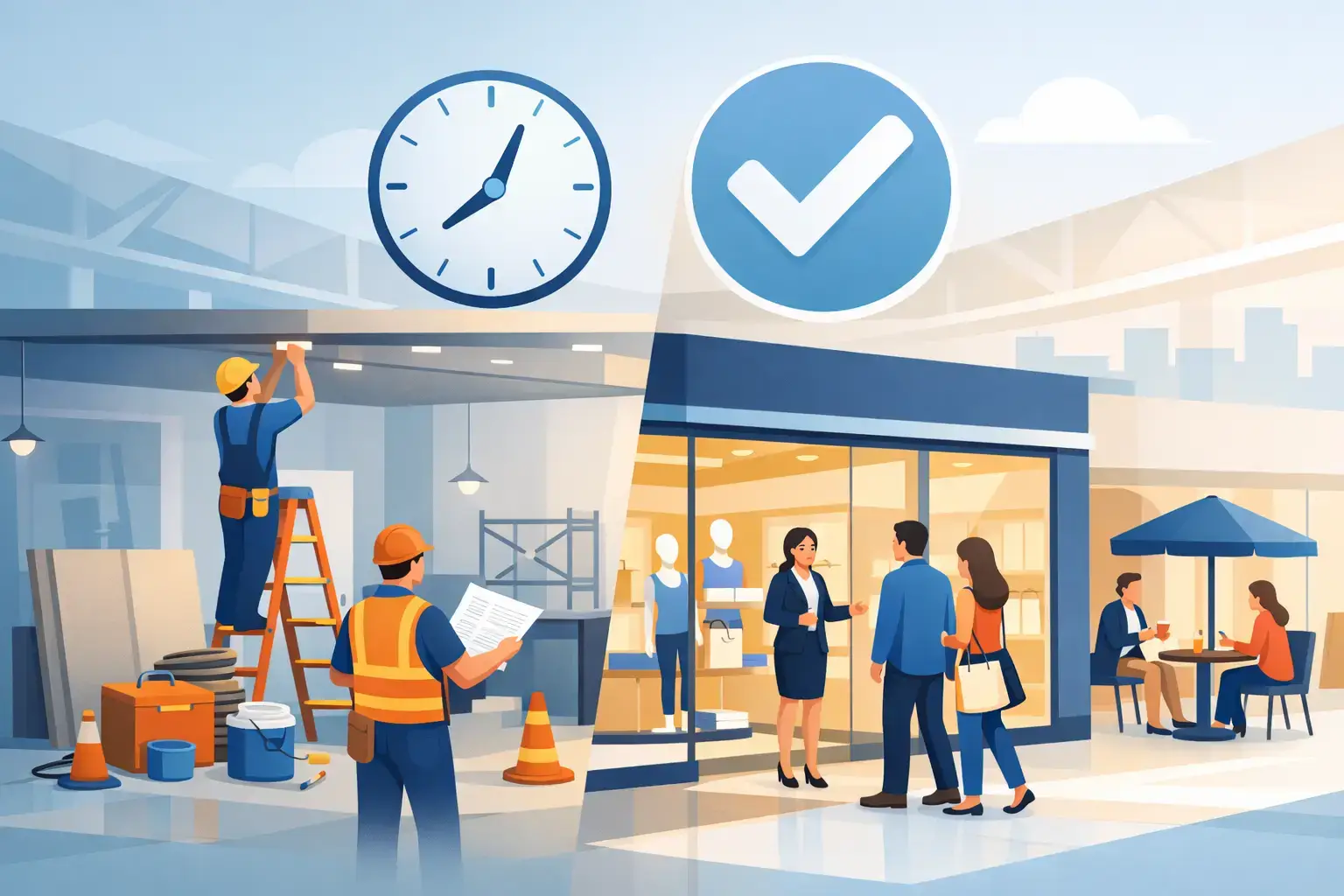
A missed store opening does more than postpone revenue. It can leave staff scheduled for a space that is not ready, delay inventory deliveries, strain a landlord relationship, and weaken the impact of a new brand launch. A successful mall tenant buildout is therefore not just a construction assignment. It is a controlled delivery process that turns an approved retail concept into a polished, operational store on a committed date.
For retail operators, developers, and expanding brands, the difference is often found in the details that customers never see: lease requirements reviewed early, materials ordered before they affect the critical path, clear coordination with mall management, and workmanship that holds up under constant foot traffic.
A Mall Tenant Buildout Starts With the Lease
Every mall has its own tenant criteria, construction rules, insurance requirements, access restrictions, and approval procedures. These are not administrative items to address after design decisions have been made. They shape the project from the first planning meeting.
The lease and tenant design criteria may define storefront standards, signage limitations, permitted working hours, noise controls, fire-life-safety requirements, utility connection procedures, delivery routes, and requirements for returning common areas in clean condition. A contractor that reviews these documents late can discover restrictions after drawings are complete or materials are already ordered. That creates avoidable revisions, cost pressure, and schedule risk.
A disciplined preconstruction review identifies what the landlord must approve, what the tenant controls, and which work requires coordination with base-building systems. For example, a new café may need grease exhaust, plumbing, and electrical capacity beyond what the original shell provides. A luxury retailer may face specific requirements for storefront glazing, lighting temperatures, ceiling transitions, or signage placement. The right approach depends on the space, the mall, and the brand, but early clarity is always less expensive than late correction.
Protect the Schedule Before Work Begins
The construction schedule should be built around the opening date, not around a general estimate of how long the work might take. Mall projects have fixed constraints that can make a short delay meaningful: limited overnight work windows, loading dock bookings, elevator reservations, mall inspections, holiday blackout periods, and required access approvals for every trade.
The most reliable schedules identify long-lead decisions early. Custom millwork, decorative lighting, specialty tile, storefront components, HVAC equipment, and branded fixtures may all affect the critical path. A refined finish is worth protecting, but it must be specified with an honest understanding of procurement timing. If a selected material cannot arrive in time, the client should see the trade-off clearly: adjust the opening date, approve a suitable alternate, or change the sequence of work where possible.
This is where transparent communication matters. A contractor should not hide a procurement issue until it becomes an emergency. Decision-makers need timely information on what has changed, how it affects cost and schedule, and which solution preserves the intended result.
Sequence Matters More Than Activity
A busy jobsite is not necessarily a controlled jobsite. On a high-quality retail fit-out, work must follow a sequence that protects finished materials and allows inspections to occur without disruption.
Rough-in work for mechanical, electrical, plumbing, fire protection, and data systems must be coordinated before walls and ceilings are closed. Flooring should not be installed before overhead work is substantially complete. Custom millwork must be measured against actual site conditions, not only drawings. Final paint, glass, feature lighting, and merchandising elements should be installed when they can be protected from damage caused by following trades.
The goal is not simply to keep every crew active. The goal is to move the project forward without rework, avoid damage to completed finishes, and maintain accountability at every handoff.
Budget Control Requires Scope Control
A mall tenant buildout can lose budget discipline when the scope is unclear. An initial number may appear attractive, then grow through exclusions, incomplete drawings, unconfirmed landlord requirements, or assumptions that were never reviewed with the client.
A dependable contractor brings visibility to the scope before construction begins. This includes confirming demolition boundaries, existing conditions, utility capacities, landlord-provided work, tenant-provided fixtures, permit responsibilities, and the full finish schedule. It also means identifying allowances and unit-cost items that may change once conditions are opened or selections are finalized.
Not every unknown can be eliminated in an existing mall space. Hidden conditions behind walls, outdated base-building information, or required upgrades can arise. What clients should expect is a clear process for handling them. The issue should be documented, its effect explained, and approval obtained before additional work proceeds whenever conditions allow.
Value engineering can support budget control when it protects the visual and functional priorities of the brand. Replacing a specified finish with a lower-cost option may be sensible if durability, appearance, maintenance, and lead time remain aligned. It is less sensible when the substitute reduces the quality of the feature customers notice first. The best decisions distinguish between cost reduction and value loss.
Build the Store Customers Will Experience
Retail construction is judged in seconds. Customers notice the storefront, lighting, flooring transitions, fixture alignment, wall finishes, and cleanliness of the completed space before they understand the product offering. For premium brands, those details are part of the business case for the buildout.
Quality control should be active throughout the project, not reserved for the final walkthrough. Mockups, material samples, finish inspections, and trade coordination help confirm that the built result reflects the approved design intent. This is particularly important at highly visible elements such as feature walls, reception or cash-wrap areas, fitting rooms, display niches, and storefront entries.
Durability also matters. A mall location experiences daily traffic, rolling stock, cleaning equipment, changing displays, and frequent customer contact. Materials should be selected and installed for their real operating environment. A beautiful floor that scratches easily, a wall finish that cannot be repaired cleanly, or poorly supported millwork can create recurring maintenance costs after opening.
Coordinate the Work Beyond the Storefront
The retail space may be contained within a tenant boundary, but the project often affects shared mall operations. Contractors need to coordinate deliveries, debris removal, temporary protection, worker access, safety protocols, and utility shutdowns with property management. Professional coordination protects both the project and the relationship with the landlord.
It also reduces surprises during closeout. Final inspections, fire alarm testing, certificates, punch-list work, cleaning, training for installed systems, and turnover documents should be planned as part of the schedule. A store is not ready because most construction is complete. It is ready when it is safe, approved, clean, functional, and prepared for staff, inventory, and customers.
Choose a Contractor for Control, Not Just Capacity
Mall work moves quickly, but speed without discipline is expensive. The contractor should be able to translate drawings and brand standards into a practical execution plan, coordinate multiple trades, communicate directly about risks, and maintain finish quality through final turnover.
Ask how the contractor manages landlord approvals, long-lead materials, change orders, daily site coordination, quality checks, and the final punch list. Review completed commercial spaces, not only early-stage renderings. The finished environment is the evidence that matters.
KADL Contracting approaches commercial fit-outs with that same focus: controlled budgets, accountable communication, on-time delivery, and luxury in every detail. For a retail brand, these are not separate promises. They are the conditions required to open a space that looks complete, operates correctly, and supports the customer experience from its first day.
A store opening is a public deadline. Treat the buildout as a coordinated business launch, give early decisions the attention they deserve, and select an execution partner prepared to protect both the schedule and the standard of the finished space.